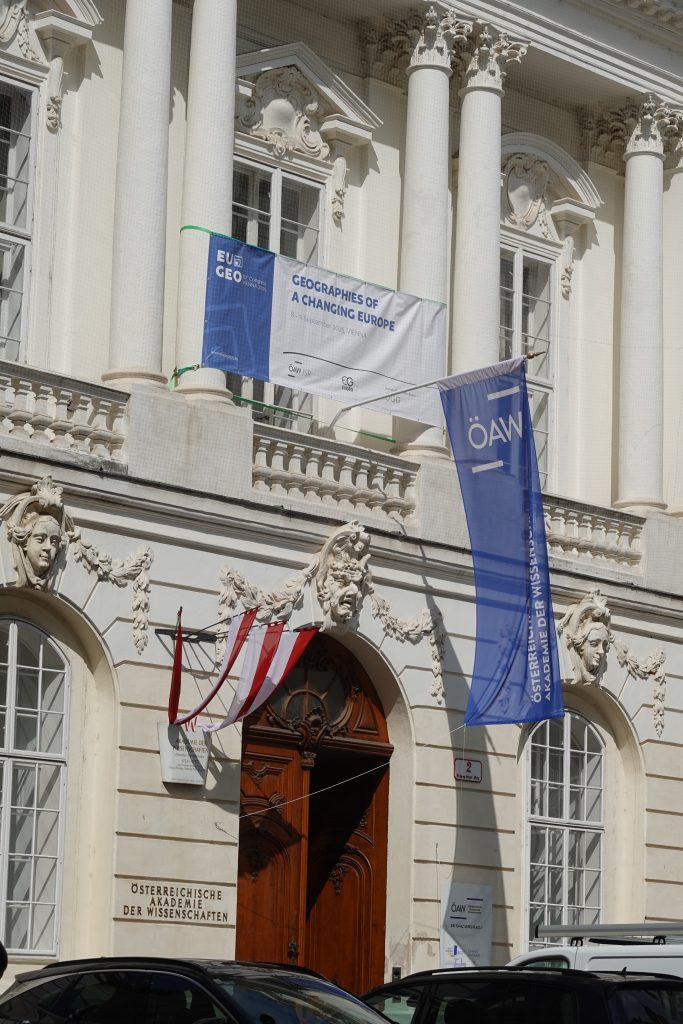
À l’occasion du congrès annuel de l’EUGEO (Association of Geographical Societies in Europe), qui s’est tenu du 8 au 11 septembre 2025 à Vienne (Autriche), Hélène Roth et Nina Gribat organisaient une session portant sur les « New Mining Futures in Left-behind Places ». Audrey Sérandour y a présenté les premiers résultats du projet MATTER, dans une communication intitulée « What do financial flows tell us about mining futures? Actors, discourses, and promises around lithium in the Rhine Graben ».
Résumé de l’intervention :
At both European and national levels, policies designed to reduce dependence on critical materials, and to extract minerals from Europe’s subsoil are taking shape since the early 2010s. These policies give rise to new mining projects in Europe. In particular, lithium is of interest to many industrial and political actors, due to its role in energy transition strategies. These extractive projects are made possible by a diversity of financial flows. European lithium projects are thus supported by private fund-raising and investment, bank loans, subsidies and public financial instruments, etc. These flows are carried out by different types of actors, who act at various scales, and support a variety of territorial projects. Based on this observation, we propose to question new mining futures by identifying and analyzing the financial flows that make lithium valorization projects possible. Who provides the capital? What narratives justify the financing of these mining projects? What territorial projects do they support?
This proposal links two fields : the political geography of resources, which studies resources making processes (Raffestin, 1980 ; Bridge, 2009); and approaches based on territorial metabolism that integrate power relations (Buclet, Donsimoni, 2020 ; Buclet, 2022). The aim is to analyze the financial flows which form the territorial metabolism of lithium, to understand how they structure networks of actors, discourses and territorial projects. Thus, this proposal takes a close look at critical resource geography’s invitation to consider the “resource-making/world-making” approach (Valdivia et al., 2022), which links construction of resources processes with production of socioecological worlds.
To do so, we focus on the lithium exploration and exploitation projects located in Alsace, France. This region has a deep history of subsoil exploitation, particularly around oil and potash, now closed. Today, new socio-industrial systems are structuring around lithium, capturing financial flows of various kinds. We analyze the role of European and national funding on the discursive framing about Alsacian lithium. According to the funding sources and the geographical scale at which a given actor is positioned, lithium discursive frames can vary from environmental protection, to national strategic autonomy, or even local economic development.