Catégorie : Événements scientifiques

[Panel de congrès] « The political geography of supply chain’s securitization » au congrès annuel de la RGS

Par Audrey Sérandour

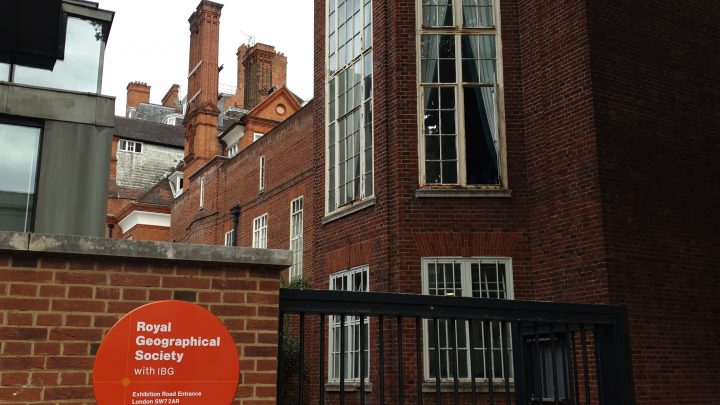
[Panel de congrès] « The political geography of supply chain’s securitization » au congrès annuel de la RGS Dans le cadre du RGS-IBG Annual International Conference 2026, qui s’est tenu du 1er au 4 septembre 2026 à Londres, Audrey Sérandour, David Schröter et Nicolas Hercelin ont co-organisé un panel portant sur les croisements entre géographie financière et géographie politique des ressources. Il s’agissait d’examiner comment les flux et instruments financiers façonnent les rapports de pouvoir autour de l’extraction, de la transformation et du transport de ressources minières et énergétiques. Résumé du panel : Resource extraction is a highly capital-intensive industry, sustained by a variety of financial flows. Whether expressed as equity investment, derivatives, bank loans, capital markets’ bonds or public finance instruments (subsidies, guarantees, etc.), these financial flows are not simply movements of capital: they shape the political geography of resources. In fact, they structure power relations (dependence, risk mitigation, governance of uncertainty, control of information, capture of value, etc.) and determine the materialization of extractive activities in space (investment locations, connections between territories, political and environmental governance, local distribution of revenues etc.). This panel proposes to examine how financial flows and financial instruments shape the political geography of resources. Drawing on constructivist approaches (Raffestin 1980; Bridge 2009), we understand resources as processes of continuous construction at the intersection of material substances, political and economic contexts, technological availability, legal frameworks, but also financial mechanisms and instruments. These mechanisms and instruments operate at different scales and are networked to different places (i.e. financial centers, offshore centers, regional markets etc). Hence construction processes of resources are entangled in financial valuation processes. This approach to resources places great importance on the notion of value. Drawing on pragmatic approaches to valuation (Hercelin 2025), « the » value of a resource, of an economic project, or of a territory is shaped by the particular rationalities of financial instruments and models (Doganova 2024) – such as expected profitability, commodification, risk management, etc. Such financial valuation practices are contested by other valuation regimes – such as inalienability of land, competiting land use, the sanctity of a substance, etc. Instruments and models themselves can also be employed in or even act as sites of resource conflicts, for example for computing the distribution of mining rents or environmental compensation. Approaching resources through the lens of financial geography raises methodological challenges. The financial world has proven difficult to access. In this panel, we wish to give space to methodological considerations: on the one hand, how can we access financial data and actors? And on the other hand, how can the tools of financial geography inform research in the political geography of resources? Interventions dans le cadre du panel : The Power to Price: Transformations in the Cobalt GPN at the Intersection of Financial and Physical Markets » Aleksandra Wojewska (Austria – University of Vienna) The Strategy of the Government of the State of Mecklenburg–Western Pomerania to Shield Nord Stream 2 from U.S. Sanctions » Sami Ramdani (France – IRIS) EU strategic autonomy, beyond narrative? Mapping EU ownership and control in manganese global production networks » Nicolas Hercelin (France – Sciences Po Bordeaux) and Paolo Balmas (Luxembourg – Luxembourg Institute of Socio-Economic Research) Plus d’informations sur le site Internet de la Royal Geographical Society.
[Communication] « Materialising green energy futures through financial flows » à la conférence EnergyEthics 2026

Par Audrey Sérandour

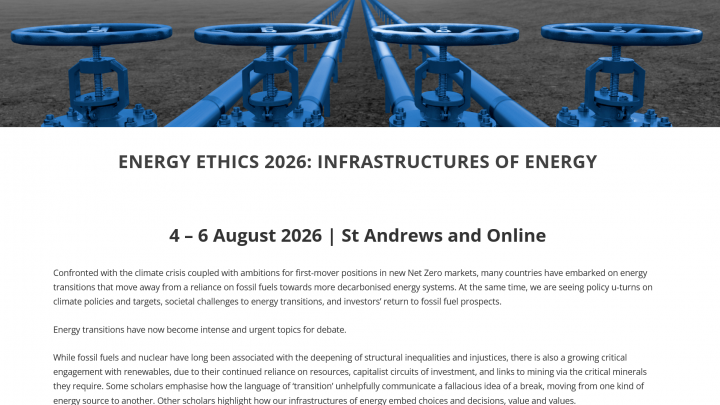
[Communication] « Materialising green energy futures through financial flows » à la conférence EnergyEthics 2026 À l’occasion du colloque EnergyEthics, qui s’est tenu à Saint-Andrews (Royaume-Uni) du 4 au 6 août 2026, les avancées du projet MATTER ont été présentées dans le cadre d’une session intitulée « Politics of Risk in Contested Energy Futures ». David Schröter a pu y présenter une réflexion menée avec Audrey Sérandour sur la notion de risque dans la géographie des flux financiers liés à des projets extractifs en Bolivie et en France. La communication était intitulée « Materialising green energy futures through financial flows: how risk is defined, mobilised and mitigated in critical raw material supply chains ». Short Abstract: In this paper we analyse the role risk plays in critical raw materials sourcing for the EU by looking at financial flows. We look at how actors arbitrate between different types of financial flows, mobilising risk to rally support for projects construed as strategic – combining profitability and geopolitical interests.

[Intervention] Préconférence LASA2026 – Liens entre UE et Amérique latine dans les transitions énergétiques

Par Audrey Sérandour

[Intervention] Préconférence LASA2026 – Liens entre UE et Amérique latine dans les transitions énergétiques En amont du congrès international de l’Association des études latino-américaines (LASA), s’est tenue le 25 mai 2026 à Paris une pré-conférence sur « (Un)just Energy Transitions: Research on Mining and Hydrogen in Latin America ». Elle était organisée par Javiera Barandiaran (UCSB), Julio Postigo (Indiana University) et Bettina Schorr (FU Berlin), avec le soutien de la LASA Environmental Section. Dans ce cadre, Audrey Sérandour était invitée à proposer un motivator talk sur la question des « EU-LAC-USA-China Entanglements: What drives and structures these entanglements, with what consequences? ». Ce fut l’occasion de réfléchir aux interdépendances entre l’Union européenne et l’Amérique latine dans le domaine de l’extraction et de la transformation des matières premières minérales.

[Workshop] Participation au workshop interdisciplinaire « Speculating with lithium », à Berne

Par Mélanie Edeline

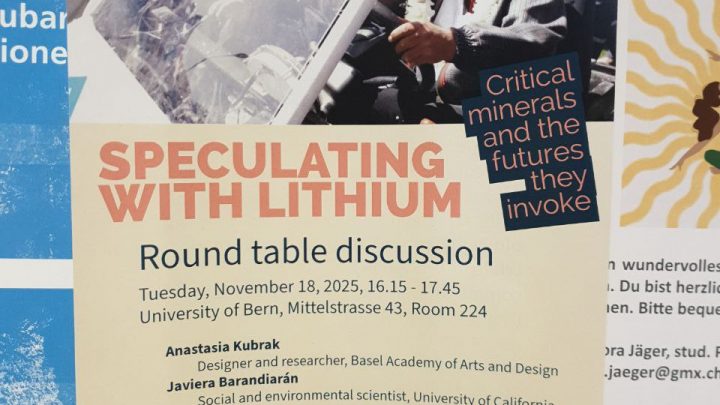
[Workshop] Participation au workshop interdisciplinaire « Speculating with lithium », à Berne Du 16 au 18 novembre 2025 s’est tenu à Berne (Suisse) un séminaire de travail interdisciplinaire réunissant des chercheuses et chercheurs de divers pays européens et sud-américains ayant comme point commun d’étudier la ressource lithium. Lors de cet atelier, les participants ont exploré les passerelles entre différentes approches (anthropologie, géographie, science politique, design, chimie…) pour comprendre les enjeux soulevés par le lithium, et en particulier les perspectives futures ouvertes par cette ressource. L’objectif était de réfléchir à la manière dont une diversité d’acteurs spéculent sur et avec le lithium. Comment le contexte mondial de forte demande en lithium façonne-t-il les visions et les actions de différents acteurs, des investisseurs aux militants en passant par les chercheurs ? Comment ces acteurs intègrent-ils le lithium dans leurs projets, l’utilisant pour donner un sens à l’avenir, revendiquer des droits ou même le façonner ? Les trois jours de workshop se sont déroulés à l’Institute of Social Anthropology de l’Université de Berne.

[Communication] Présentation des travaux du projet MATTER à l’ITI GeoT, à Strasbourg

Par Mélanie Edeline

[Communication] Présentation des travaux du projet MATTER à l’ITI GeoT, à Strasbourg Le 5 novembre 2025, les travaux du projet MATTER ont été présentés aux collègues de l’Institut thématique interdisciplinaire (ITI) GeoT (Géosciences pour la transition énergétique)n à Strasbourg. Résumé de l’intervention : At both European and national levels, policies designed to reduce dependence on critical materials, and to extract minerals from Europe’s subsoil are taking shape since the early 2010s. In particular, lithium is of interest to many industrial and political actors, due to its role in energy transition strategies. These extractive projects are made possible by a diversity of financial flows. Who provides the capital? What narratives justify the financing of these mining projects? What territorial projects do they support? Focusing on the case of lithium in the Rhine Graben, the aim of this presentation is to analyze the resource-making processes by which this material element is embed within territorial projects.

[Communication] Intervention au congrès annuel de l’EUGEO, à Vienne

Par Mélanie Edeline

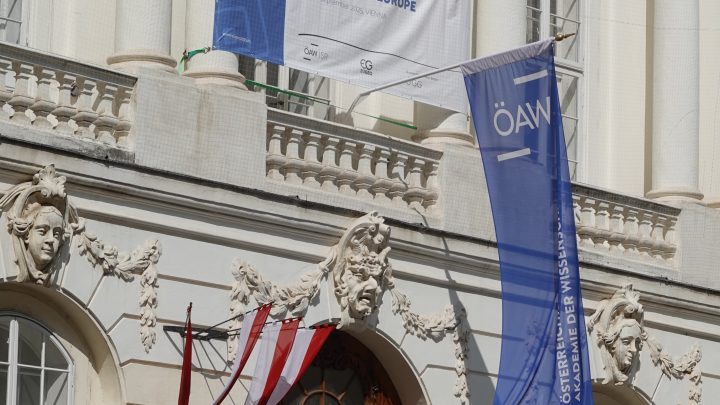
[Communication] Intervention au congrès annuel de l’EUGEO, à Vienne À l’occasion du congrès annuel de l’EUGEO (Association of Geographical Societies in Europe), qui s’est tenu du 8 au 11 septembre 2025 à Vienne (Autriche), Hélène Roth et Nina Gribat organisaient une session portant sur les « New Mining Futures in Left-behind Places ». Audrey Sérandour y a présenté les premiers résultats du projet MATTER, dans une communication intitulée « What do financial flows tell us about mining futures? Actors, discourses, and promises around lithium in the Rhine Graben ». Résumé de l’intervention : At both European and national levels, policies designed to reduce dependence on critical materials, and to extract minerals from Europe’s subsoil are taking shape since the early 2010s. These policies give rise to new mining projects in Europe. In particular, lithium is of interest to many industrial and political actors, due to its role in energy transition strategies. These extractive projects are made possible by a diversity of financial flows. European lithium projects are thus supported by private fund-raising and investment, bank loans, subsidies and public financial instruments, etc. These flows are carried out by different types of actors, who act at various scales, and support a variety of territorial projects. Based on this observation, we propose to question new mining futures by identifying and analyzing the financial flows that make lithium valorization projects possible. Who provides the capital? What narratives justify the financing of these mining projects? What territorial projects do they support?   This proposal links two fields : the political geography of resources, which studies resources making processes (Raffestin, 1980 ; Bridge, 2009); and approaches based on territorial metabolism that integrate power relations (Buclet, Donsimoni, 2020 ; Buclet, 2022). The aim is to analyze the financial flows which form the territorial metabolism of lithium, to understand how they structure networks of actors, discourses and territorial projects. Thus, this proposal takes a close look at critical resource geography’s invitation to consider the “resource-making/world-making” approach (Valdivia et al., 2022), which links construction of resources processes with production of socioecological worlds.   To do so, we focus on the lithium exploration and exploitation projects located in Alsace, France. This region has a deep history of subsoil exploitation, particularly around oil and potash, now closed. Today, new socio-industrial systems are structuring around lithium, capturing financial flows of various kinds. We analyze the role of European and national funding on the discursive framing about Alsacian lithium. According to the funding sources and the geographical scale at which a given actor is positioned, lithium discursive frames can vary from environmental protection, to national strategic autonomy, or even local economic development.

[Panel de congrès] Co-organisation d’un panel au congrès annuel de la RGS – « The political geography of supply chain’s securitization »

Par Mélanie Edeline

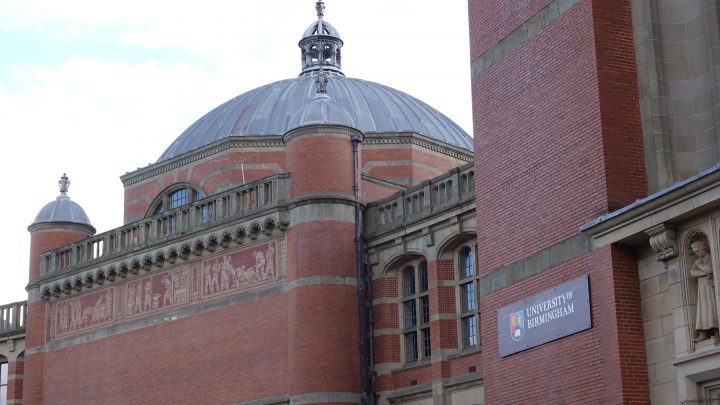
[Panel de congrès] Co-organisation d’un panel au congrès annuel de la RGS – « The political geography of supply chain’s securitization » Dans le cadre du RGS-IBG Annual International Conference 2025, qui s’est tenu du 26 au 29 août 2025 à Birmingham, Teva Meyer et Audrey Sérandour ont co-organisé un panel portant sur la géographie politique de la sécuritisation des chaînes d’approvisionnement.   Résumé du panel : From raw materials to electricity, from surgical masks to semiconductors, the security of supply chains has become a central topic in political debates, especially following the successive crises of the Covid-19 pandemic and Russia’s large-scale war in Ukraine. These disruptions have prompted the development of new national and supranational security policies. Championed by both public and private actors, these efforts aim to reconfigure supply chains to reduce the risks of dependency and enhance “sovereignty” in the face of identified threats. Supply chains have been extensively examined through the lens of security studies (Judge, Maltby, and Szulecki 2018), leading to two divergent approaches. The first one focuses on defining and quantifying supply security through the development of indicators and metrics, seeking to identify what makes a supply policy secure. The second one, rooted in critical approaches inspired by the Copenhagen School of “securitization,” argues that security is not an inherent or objective reality but a political construct shaped by processes that designate certain issues as security concerns (Wæver 1999). However, recent research on energy supply security calls for greater integration of these approaches, challenging the dichotomy between “objective” and “constructed” security (Szulecki 2020). Security is neither a purely representational construct detached from material realities nor a universal metric that can be uniformly applied, but exists at the intersection of these dimensions. This session proposes that “space” offers a valuable framework for bridging these perspectives for two key reasons. First, even though “geographers were latecomers to the critical study of security” (Kuus 2010), the interest of political geographers in this field has proliferated since then, demonstrating that space serves both as the object and the container of securitization, as well as a tool for it. Recent geographical inquiries into security issues have delved into deconstructing the practices, performances, and materializations of endangerment narratives using spatial imaginaries (Billon 2015). Security policies are produced through the categorization of space between sources of danger and sources of stability, zones of peace and zones of turmoil (Dalby 2009). Thus, security policies are space-based practices, where ‘space’ refers not only to what is being securitized or the contingent receptacle in which it occurs, but rather to what enables issues to be securitized. Second, the implementation of supply chain security policies hinges on risk analyses of the threats posed to the routes and nodes through which materials flow. These spaces—corridors and places—are marked by varying levels of fluidity and interchangeability due to their material, economic, and sociopolitical characteristics. Such variations create vulnerabilities that can lead to deliberate or accidental disruptions (Balmaceda 2021). Plus d’informations sur le site de la Royal Geographical Society.
[Communication] « La mise en ressource du lithium dans le Fossé rhénan » : contribution au séminaire sur « La mise en ressource des milieux » au CERI-SciencesPo

Par Mélanie Edeline

[Communication] « La mise en ressource du lithium dans le Fossé rhénan » : contribution au séminaire sur « La mise en ressource des milieux » au CERI-SciencesPo Le séminaire « Échanger, extraire, empêcher. La mise en ressource des milieux » organisé par Pia Bailleul et Inés Calvo Valenzuela au CERI, SciencesPo vise à décrire de quelles manières les milieux et leurs matières sont mis en ressources, et à appréhender les effets (représentations, tensions, relations, etc.) qui émergent de ces processus. Dans ce cadre, Audrey Sérandour a présenté les avancées du projet MATTER dans une communication intitulée « La mise en ressource du lithium dans le Fossé rhénan : une approche par le métabolisme territorial », le 19 juin 2025, à Paris. Plus d’informations sur le séminaire disponibles sur le site du CERI – SciencesPo : https://www.sciencespo.fr/ceri/fr/recherche/grp-sem/extraire-echanger-empecher-la-mise-en-ressource-des-milieux/

[Communication] « Une transition à quelle échelle ? » : contribution à une journée d’étude sur les transitions énergétiques dans le monde rural (projet CRAFT)

Par Mélanie Edeline

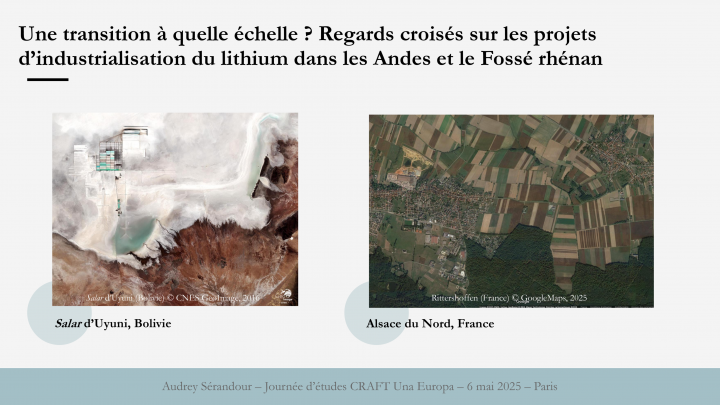
[Communication] « Une transition à quelle échelle ? » : contribution à une journée d’étude sur les transitions énergétiques dans le monde rural (projet CRAFT) La journée d’étude « Penser les transitions énergétiques dans le monde rural » s’est tenue le 6 mai 2025 à la Sorbonne (Paris). Elle visait à questionner les enjeux de la transition énergétique, notamment dans les zones rurales à travers un dialogue interdisciplinaire et multi-situé. Elle émane du projet CRAFT (Contested Rural Transitions: Embracing Conflicts through Participatory Research) portant sur les conflits socio-environnementaux et les questions de transitions dans les zones rurales, notamment en Europe. Ce projet vise à développer des modèles de recherche-action participative permettant d’embrasser les contestations ou conflits en question. Il est porté par l’université de KU Leven-Belgique ; Alma mater studiorum Università di Bologna – Italie ; Uniwersytet Jagielloński w Krakowie – Pologne et l’Université Paris 1 Panthéon-Sorbonne dans le cadre du dispositif Una Europa. Dans ce cadre, Audrey Sérandour a présenté les premières réflexions du projet MATTER en les mettant en perspective avec les terrains sud-américains, à travers une communication intitulée « Une transition à quelle échelle ? Regards croisés sur les projets d’industrialisation du lithium dans les Andes et le Fossé rhénan ». Plus d’informations sur la journée d’étude disponibles sur le site de l’Université Paris 1 Panthéon-Sorbonne.

[Communication] Contribution au séminaire du groupe de travail « Politisation du sous-sol »

Par Mélanie Edeline

[Communication] Contribution au séminaire du groupe de travail « Politisation du sous-sol » Le groupe de travail « Politisation du sous-sol » a été initié dans le cadre du Programme et équipements prioritaires de recherche (PEPR) « Sous-sol, bien commun », et plus spécifiquement de l’un de ses projets ciblés, intitulé « Vers la politisation et la requalification du sous-sol » (Vertiqual). Il vise à faire émerger des liens entre les chercheurs et chercheuses ayant engagé des travaux sur les industries et chaînes de valeurs qui se développent et se recomposent en lien avec l’extraction, l’usage des matières premières issues du sous-sol, et la transition énergétique. L’objectif est de participer à la constitution d’une communauté de recherche en sciences humaines et sociales sur ces enjeux. Le séminaire est organisé par Sébastien Chailleux, Quentin Deforge et Nicolas Hercelin. Lors de la séance du 4 février 2025, Audrey Sérandour a présenté son travail de doctorat sur la géographie politique du lithium andin.